Did a burst pipe or a leaking water heater just ruin your weekend?
The aftermath of plumbing emergencies is a daily reality in the Imperial Valley. Hard water is almost always the silent culprit hiding right inside those broken pipes.
The team at El Centro Plumbing Pros knows exactly how quickly this untreated water destroys appliances. You can actually stop this damage before it causes another expensive flood.
We are going to walk you through the exact water softeners and reverse osmosis setups that save homes. Let’s get your plumbing protected for good.
Treatment sized for the water we actually have
In a lot of markets, water treatment is just an optional upgrade. We consider it essential preventive maintenance because of what flows through local pipes. The Imperial Valley runs on Colorado River water delivered through the All-American Canal and Imperial Irrigation District facilities.
Our local data from El Centro’s annual water quality report puts total hardness at 340 to 350 mg/L as calcium carbonate. That equates to roughly 20 grains per gallon of hardness. We look at the national threshold for “very hard” water, which is only 180 mg/L. This means the water in your home is at nearly double that limit.
Our focus is not on health or compliance, but on the severe plumbing damage this water causes. Untreated hard water attacks your home in several specific ways:
- Scales shower heads and fixtures rapidly.
- Wears out delicate faucet cartridges.
- Seizes up critical plumbing valve seats.
- Destroys hot water tanks prematurely.
We routinely replace water heaters that burst in just six years due to scale, missing their expected 12-year lifespan entirely. The Water Quality Association has documented that these early failures are standard in hard water regions. Our sizing process matches the unit’s grain capacity directly against your daily household water use.
At El Centro’s extreme hardness level, getting this math right matters more than anywhere else in California. An undersized unit that regenerates too often, burns salt, and exhausts its resin early is the wrong fit. An oversized system is simply money spent on capacity you will never use.
What each system actually does
We use four main approaches to handle water quality issues in the home. Each option serves a very specific purpose.
Ion-exchange softener: We recommend this system because it physically swaps calcium and magnesium for sodium on a resin bed, then regenerates with brine. This is the only one of the three options that genuinely removes hardness to protect your water heater, supply lines, and fixtures. Our customers often ask about the sodium added during this process. At 20 grains of hardness, the exchange adds about 150 milligrams of sodium per quart of water, which is less sodium than a single slice of bread.
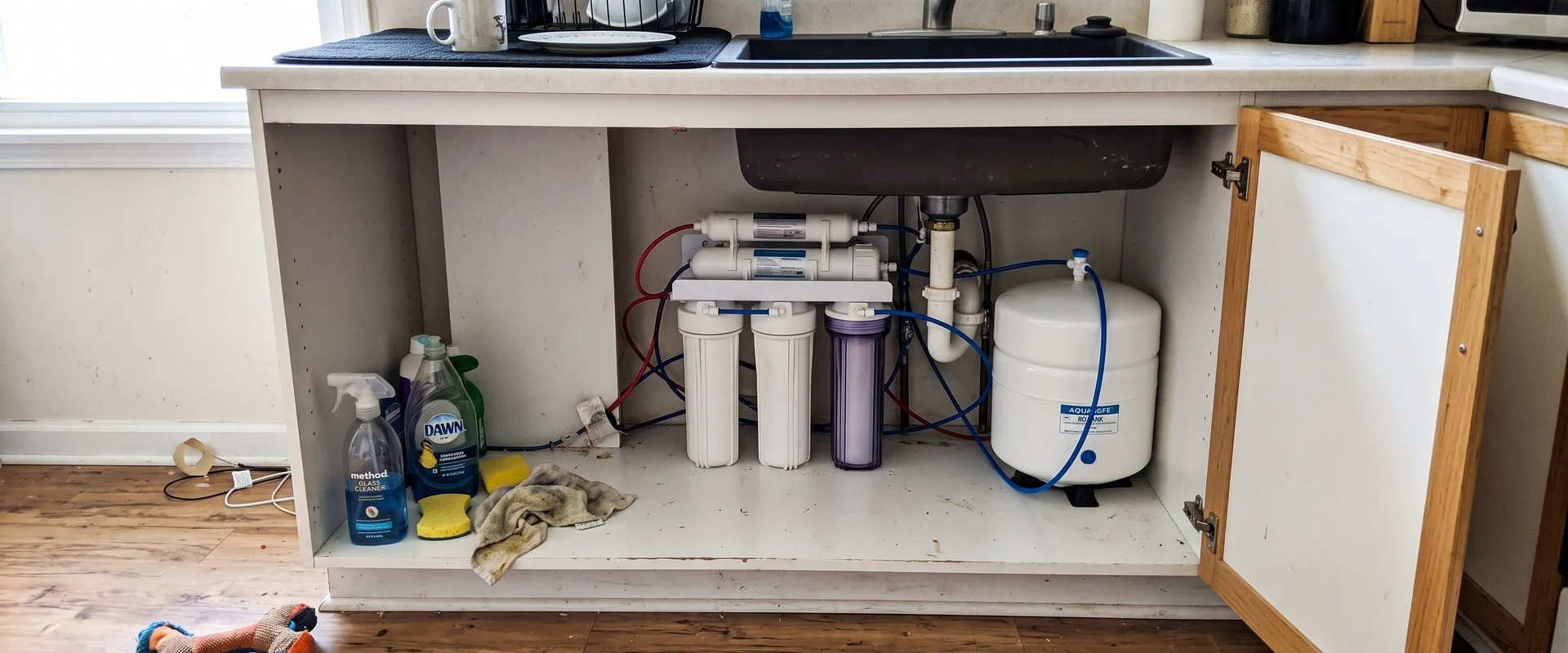
Under-sink reverse osmosis: We install these units to push water through a semi-permeable membrane to reduce total dissolved solids at a single drinking tap. An industrial-grade reverse osmosis membrane will achieve a 95 to 99 percent rejection rate, stripping out dissolved minerals and contaminants. Our goal with this system is to fix the taste and mineral content directly in your glass. It does nothing for the rest of the plumbing in the house.
Whole-house filtration: We utilize sediment and carbon stages to reduce grit, chlorine taste, and odor across every fixture. These filters are highly useful for overall water quality, but they are not a hardness solution.
Salt-free conditioners: Our assessment of these units is that they change the form of scale so it is less likely to adhere to pipes. At 20 grains per gallon, this technology is a compromise rather than an equivalent to true softening. We always tell people the truth about these limits before installation. Many homes end up with a softener protecting the plumbing and an RO tap for drinking water. Our preferred combination covers both problems without paying twice to solve the exact same issue.
How we size a system
Sizing a residential system requires exact math to prevent premature failure. We start by testing the exact hardness at your specific fixture. City averages provide a helpful starting point, but they are not a precise measurement for your home. The plumber often find that an older galvanized supply line can dramatically change what actually shows up at the tap. The next step involves some straightforward daily calculations.
We calculate daily water use, multiply it by the hardness level, and find your daily grain removal requirement. The Environmental Protection Agency states that an average person uses about 75 gallons of water indoors each day. Our math shows that a four-person household at 20 grains of hardness is removing something on the order of 4,000 to 5,000 grains a day. That daily load rules out the smallest, cheapest units immediately. We typically recommend a standard 32,000 or 48,000-grain capacity system to cover that demand with a reasonable time between regenerations.
Here is a quick look at how capacity changes based on household size:
| Household Size | Estimated Daily Gallons | Suggested Softener Capacity |
|---|---|---|
| 1-2 People | 150 Gallons | 24,000 - 32,000 Grains |
| 3-4 People | 300 Gallons | 32,000 - 48,000 Grains |
| 5+ People | 400+ Gallons | 64,000+ Grains |
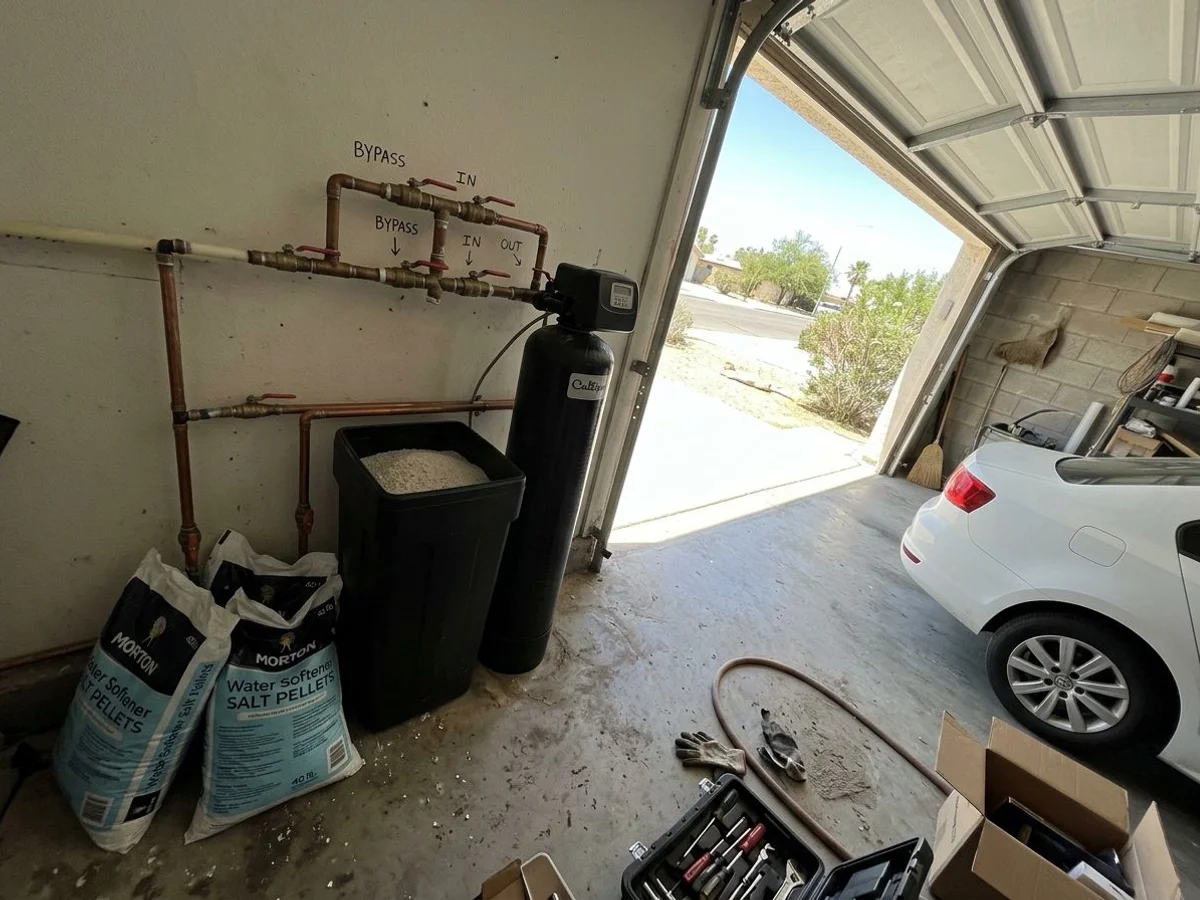
Our installation team places the softener on the main line with a bypass valve so the house can run untreated during service. The setup must include a drain line with a proper air gap to meet plumbing codes safely. We also make sure the brine tank sits somewhere you can actually get a heavy salt bag to without moving your car. Proper placement makes long-term maintenance much easier to handle.
What changes after treatment
We notice the visible things happening almost immediately after installation. You will see no more white crust on shower heads and aerators. Our clients love pulling glassware out of the dishwasher that is actually crystal clean. You will even find that regular bath soap lathers up with much less effort.
We know that the things that matter more happen quietly inside your walls. Your water heater stops accumulating a scale blanket over the burner and holds its heating efficiency. Our research into a landmark study by the Battelle Memorial Institute shows that gas heaters lose up to 48 percent of their efficiency on 30-grain hard water. Eliminating that scale prevents massive energy waste and lowers your utility bills.
Treatment also gives sensitive plumbing components a break from the daily wear and tear. Treatment protects these vital areas of your system:
- Faucet cartridges and valve seats stop grinding themselves down against sharp mineral deposits.
- Tankless heat exchangers hold their required descaling interval far longer without clogging.
- Showerheads avoid the 75 percent drop in flow rate that typically happens on hard water within 18 months.
The plumber know that a tankless unit can completely fail in just 1.6 years on hard water, according to that same Battelle study. Preventing those catastrophic failures is the true financial return on the equipment.
We tend to bring up treatment options when we are already at your house replacing a heater that scale destroyed. Fixing the root cause stops the cycle of emergency plumbing repairs. The team has compiled even more detail in our water treatment guides. A proper setup guarantees you will not be calling us for another early appliance failure, so reach out today to get your water tested.